

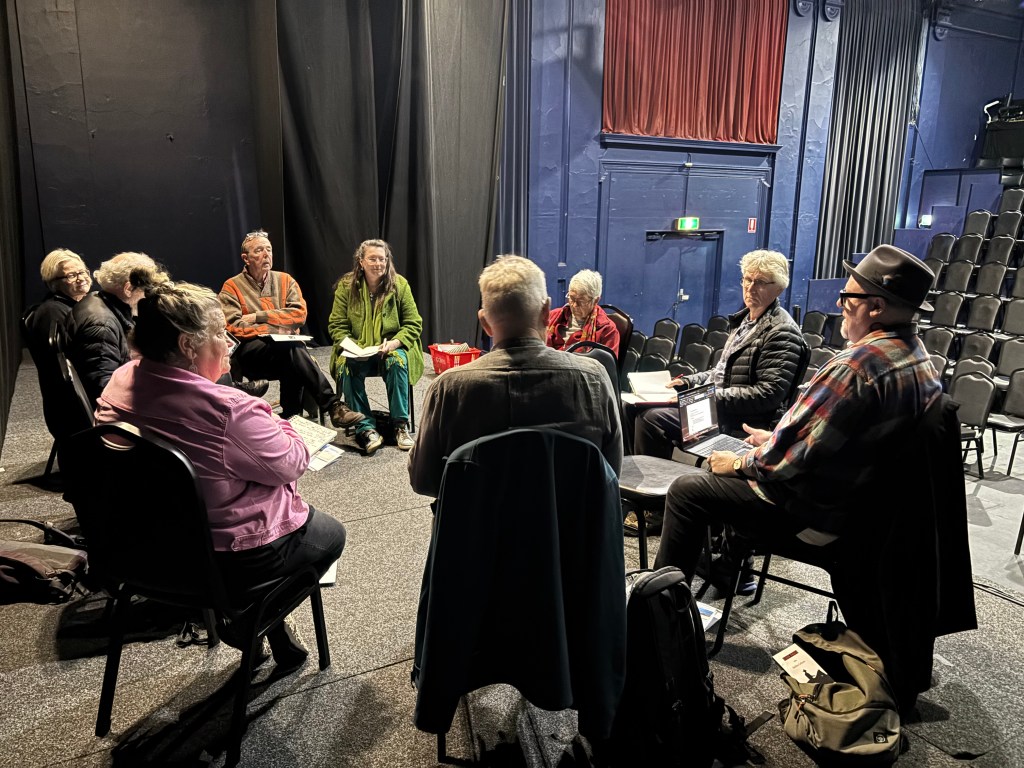
The Fringe Myrtles devoted our most recent meeting to a discussion about the haiku of Santōka Taneda, regarded as one of the leading figures of free-form haiku in Japan during the early 20th century. Our meeting was held in a hybrid fashion (with mixed success) some of the group meeting face-to-face at the Athenaeum Theatre and others joining online.
Prior to the meeting, Rob distributed some reading materials that provided the group with biographical details and examples of Santōka’s work.
Santōka’s early writing conformed to the traditions of the day but was soon influenced heavily by other free-verse poets such as Ogiwara Seisensui who moved to make haiku more expressive of the poet’s emotions and free of traditional forms such as the 5-7-5 syllable format and even the seasonal word. To them, haiku was more a matter of content than of style; what unfolded before the poet became the poetry; there was no room for the “lie” of décor or self-conscious technique.
Santōka’s writings were also rooted in Zen Buddhism, with a strong emphasis on his own personal spiritual journey and his haiku are often autobiographical, capturing moments from his life as a wandering monk.
just as it is
it rains, I get wet,
I walk
at times I stop begging looking at mountains
my stark naked body
revealed to the sun
daily torn and tattered
turning to shreds
my robe for travelling
this body still alive scratching it
After reading and discussing his life and poetry, group members were asked to reflect on this for inspiration for writing some haiku in the same ‘style’ as Santōka. Many poems were written and shared on another enjoyable afternoon of haiku for the Fringe Myrtles.
Discover more from Australian Haiku Society
Subscribe to get the latest posts sent to your email.
 Australian Haiku Society