

- President’s Message – Reflecting on Haiku Musings
- Publications
- New group forming in Brisbane
- Latest Haiku String books
President’s Message – Reflecting on Haiku Musings
Summer has officially begun in southern Australia, while in northern parts cyclone Fina announced the wet season’s arrival. Back in the middle of spring AHS invited haiku musings in response to the question What do you find most helpful when writing haiku?
Thank you to all who took the time to participate and respond to others in rich conversation. We received a variety of thoughts on a wide range of topics. There were 12 unique contributors, who made 52 posts in total. Some shared example poems; Alan Summers even broke down a poem word-by-word. Some comments were of a practical nature, while others delved more into the philosophy of haiku. I invite you to return to these musings whenever you are looking for new insights or tips.
One theme that emerged was around the role of readers – not just of the finished poem, but also in shaping poems through feedback.
Lynette Arden: “What I find most helpful in writing haiku is nothing to do with rules or guidelines or where I happen to be located; it is the sense that I am sharing something of what I experience.”
Rob Scott: Feedback “plays a vital role in writing haiku because it offers a perspective beyond our own immediate vision. … feedback provides a mirror, showing us how that moment lands with another reader.”
Another theme was about the value of paying attention to details, such as when engaged in a ginkō.
Rose van Son: “Walking the forest trails is one of my favourite pastimes. So much to see on the forest floor, so much to discover high in the trees. Walking is a journey of discovery: the river, the beach, even to the end of the street, there is so much to unearth, to haiku.”
Leanne Mumford: “Going on a ginkō takes me out of my normal routine and allows me to pay attention to the ‘here and now’ of whatever environment I’m in. … The rhythmic activity of walking is also good for allowing memories and thoughts to flow freely …”
Thinking about the craft of haiku, participants offered some very helpful insights.
Rob Scott: “I’m attentive to juxtaposition—how two images, placed with care, can spark something larger than either alone. … I aim for spaciousness over explanation, trusting the reader to step into the silence between lines.”
Ivan Cole: “What I love about Haiku is getting to the absolute essence of an idea or an image and then juxtaposing this with a different [image] or an insight that makes the original image deeper.”
As the year of 2025 draws to a close, I’d like to wish haiku poets a creative holiday season. I look forward to engaging with you again in 2026.
– Leanne Mumford
Publications
Dr Grant Caldwell has contributed a 20-page chapter on haiku for the De Gruyter Handbook of Poetic Forms.
The chapter examines the history and the main players of the haiku form, from Bashō and other recognised masters, to other lesser known but important poets. The chapter also examines the key principles and the migration of haiku out of Japan.
The book is available online now from De Gruyter Brill.
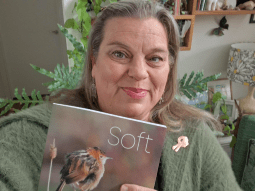
Soft, a book of haiku by Robyn Cairns, launched in Footscray.
Review by Jennifer Sutherland
Undeterred by a blustery wet afternoon in the middle of November, a small group of poets, artists and friends gathered at The Chestnut Tree Café and Bookshop in Footscray to officially launch the latest haiku book titled Soft by Robyn Cairns.
The warmth of the atmosphere of camaraderie and enthusiasm soon made up for the weather as Robbie welcomed all of us starting with Acknowledgement of Country, elders past and present. Robbie then talked about how her camping holidays to bushland and coastal areas of Australia with her family, her birdwatching and infinite love of nature provided the inspiration for Soft.
This was followed by an introduction to Soft by Jennifer Sutherland highlighting an appreciation of haiku as a poetry form and this lovely collection.
Robbie read selected haiku from her book then haiku poets in attendance, Marisa Fazio, Madhuri Pillai, Jennifer Sutherland and Rodney Williams also each read haiku from Soft and then a few of their own haiku in keeping with the soft theme. It was a delight that other guests (not haiku poets) were also keen to join in and read a haiku or two from the collection. Kate Gorringe-Smith, an artist and birding friend of Robbie’s, read the following haiku, which was inspired by a shared moment observing Golden- headed cisticolas swaying on tips of wetland reeds.
birding sister days golden cisticola
Theatre artist, Clarissa Leach was then invited to sing a haiku in her best operatic voice. She filled every bookshelf and the souls of all in attendance.
that one shell that speaks whale song
After the readings, we all raised a glass of champagne to toast Soft and enjoyed an array of nibblies and lively conversation.
Soft by Robyn Cairns
All haiku and photos by Robyn Cairns.
Published by Robyn Cairns
Typeset by Helen Christie, Blue Wren Books
Printed and bound by Ingram Spark
ISBN 978-1-7640707-0-6
Available to purchase direct from Robyn Cairns.
Email Robyn at rbcairns68@gmail.com
New group forming in Brisbane
Duncan Richardson writes:
Early in 2026, I’m planning to start a haiku and related forms group to discuss and give constructive feedback on members work, if they so desire. The related forms include senryu, tanka and haibun, as well as haiku in various forms. The group will probably meet in the Brisbane Central Library, in one of the meeting rooms, which is close to buses and train stations. Times and days have yet to be decided. Writers at all levels of experience are welcome and can contact me at duncrich@outlook.com.
Latest Haiku String books
Since July work has continued on compiling the Haiku String books. We have now published 16, with only two more to compile to complete the archive to date. Recent additions include Summer Solstice 2018, Spring Equinox 2019, Winter Solstice 2021, Autumn Equinox 2023, Spring Equinox 2023 and Winter Solstice 2024.
This edition of Members’ News compiled by Alison Rogers and Leanne Mumford.
Discover more from Australian Haiku Society
Subscribe to get the latest posts sent to your email.
 Australian Haiku Society