


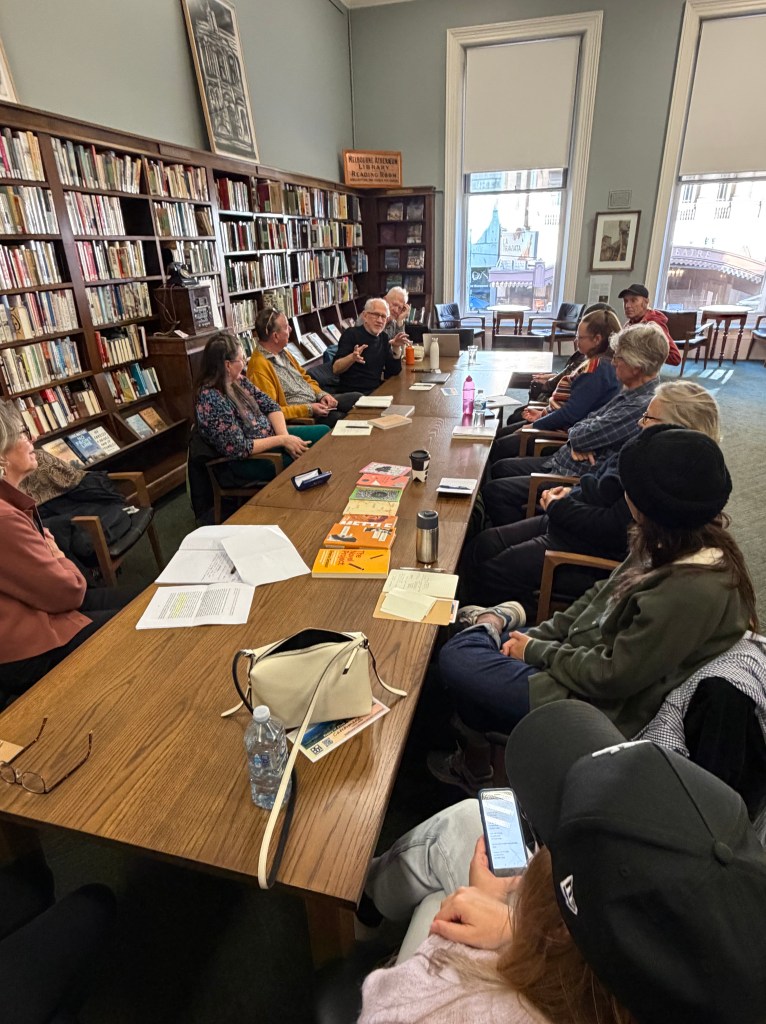
For our latest meeting, we were treated to a presentation by Grant Caldwell on the principle of fueki ryūkō in the writing of haiku. It was an illuminating presentation that provoked much thought and discussion among the gathered members. Prior to the meeting, Grant circulated some reading material to help prepare the group. Present at the meeting were: Grant Caldwell, Rodney Williams, Anna Fern, Maurice McNamara, Laura DeBernardi, Helen Williams, Liv Saint-James, Bee Tenni, Di Cousens, Thomas Landgraf, Louise Hopewell, Marisa Fazio, Rob Scott.
Grant sees fueki ryūkō — “the unchanging and the ever-changing” — as a central principle of haiku, but not one limited to Japanese culture. While he acknowledges that the term itself is specific to Japanese poetics, and in particular, Bashō’s understanding of haiku, he argues that the underlying idea is universal and can be found across world literature and philosophy. He provided numerous examples of this throughout the meeting.
For Grant, fueki refers to enduring or universal truths, while ryūkō refers to the shifting, immediate particulars of lived experience. In haiku, the poet captures a fleeting moment in such a way that it gestures toward something timeless. Numerous times during the presentation, Caldwell linked this notion to the broader poetic idea that “the universal is contained in the particular,” citing James Joyce, Heraclitus, and Daoist philosophy as parallels to Bashō’s concept.
Grant was at pains to suggest that non-Japanese poets do not need deep knowledge of Japanese language or culture in order to write effective haiku, because the essential spirit of haiku is grounded in universal human observation of nature, time, place, and experience. What matters is an awareness of the underlying poetics — attentiveness, simplicity, and the ability to reveal the universal through ordinary moments. Drawing from Bashō again, he emphasised the importance of ‘plain speaking’ in composing haiku, which helps us to produce work that preserves, as Robert Hass puts it, the “irreducible mysteriousness of the images themselves.”
Ultimately, Caldwell sees fueki ryūkō as a living balance between tradition and renewal. Haiku poets outside Japan should learn from the Japanese masters, but not imitate them mechanically. With a final nod to Bashō, he argues that poets should “seek what the old poets sought” — the revelation of enduring truth within the fleeting moment of everyday life.
Inspired by the presentation and subsequent discussion, which was engrossed as it was varied, Di Cousens penned the following haiku:
Koroit Country –
the stone axe holds its time
below the lava flow
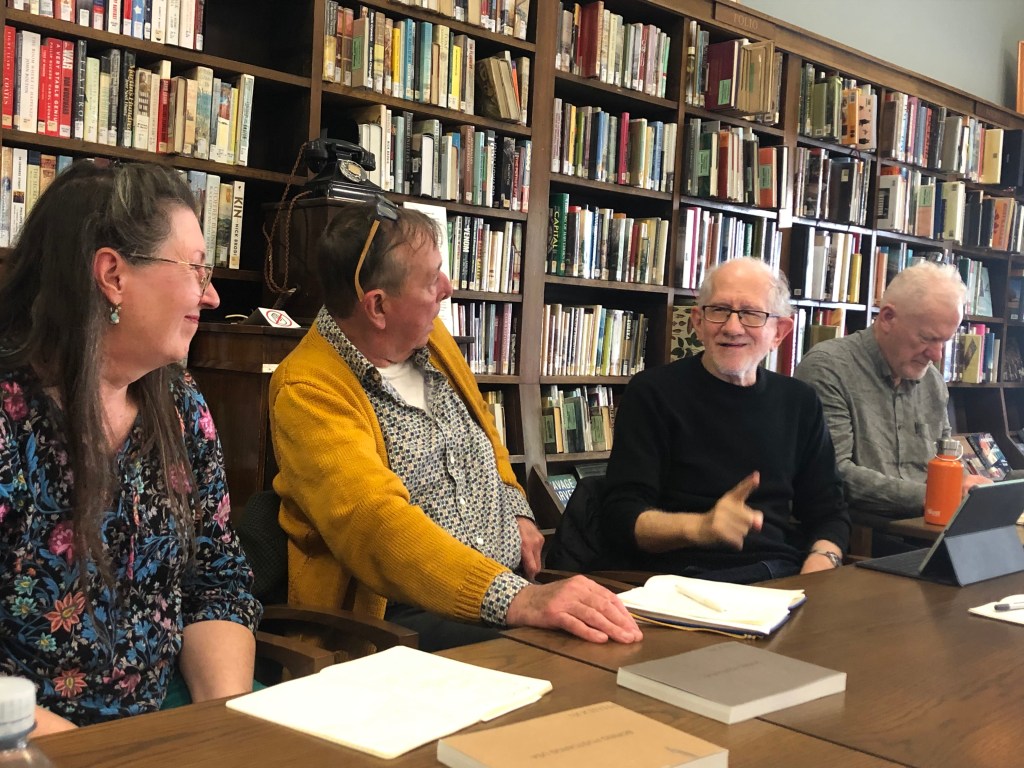
Photo courtesy of Di Cousens.
Discover more from Australian Haiku Society
Subscribe to get the latest posts sent to your email.
 Australian Haiku Society
Thanks, Rob, Terrific summation.
I thought the FM group might be interested in the attached photos of the kukai group of farmers in the hills above Nagano that I mentioned and that some people asked about. There are a few members who had left when we took the photos. Most in the photo are the retired farmers I spoke of. The one 85 y.o. not retired farmer is sitting on the right as we look at the photo. The first photo contains my friend, the artist, Mayu Kanamori who invited me to the kukai, standing on the far left. Tang Yi and I stayed with Mayu and her partner, Martin Edmond, in the snowy Shinano hills above Nagano.
Btw I hope you don’t mind me mentioning that Marisa’s partner, Kieran Carroll an old (as in time and long-time-no-see) friend of mine also attended on Sunday.
I’m not sure if this email goes to the gang but if not, if you think it might the of interest, please pass it on.
With thanks, Grant
LikeLike