


Dear Members,
I am delighted to be able to announce the winners of the 2022 John Bird Dreaming Award for Haiku. The response to the competition was fantastic once again, and I would like to extend a huge thanks to all poets for contributing their poems.
Our judges have chosen their top three haiku and honourable mentions whose poems appear below. I would like to thank the judges, Sandra Simpson and Louise Hopewell for their diligence and support for this award. I would also like to express my deep gratitude again to Ron Moss for providing the winners with beautiful ink drawings featuring their poems.
Rob Scott,
President, AHS
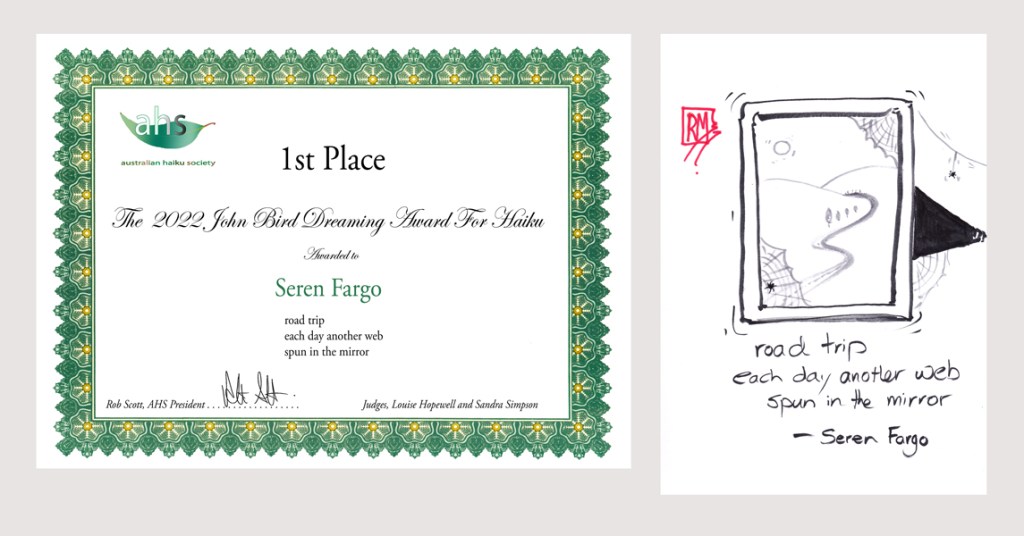


John Bird Dreaming Award for Haiku — 2022 Results
Sandra Simpson and Louise Hopewell, Judges
It has been our pleasure to judge the Second John Bird Dreaming Award for Haiku, which drew 663 poems from 235 poets in 45 countries. Our congratulations to the winners, and our best encouragement to all the other entrants. Haiku is one of the most rewarding poetry forms out there, so please keep writing! The poems selected here are all fine examples of writers in touch with their surroundings and may serve as exemplars for those wishing to understand this most under-stated, yet profound, form.
First Place
road trip
each day another web
spun in the mirror
– Seren Fargo, USA
It seems the driver at least has a hitch-hiking spider for company, one who every morning leaves a ‘calling card’. But beneath the surface there’s the human connotation of ‘spinning a yarn’ – perhaps the driver is entertaining themself or has a passenger, maybe a new hitch-hiker every day – and also a certain darkness from ‘spun in the mirror’. Is the driver making this trip for pleasure or of necessity? Is the driver practicing a daily reinvention, fully aware of the deception? Other literary references reinforce the mystery: ‘what a tangled web we weave, when first we practice to deceive’; and the poor, cursed Lady of Shalott who could look upon Camelot only in a mirror and ‘whose web was woven curiously’. The plosive consonants help accentuate the ‘noir’ feel of this haiku.
Sandra
The spirit a long road trip is effectively captured in this haiku. With an intrepid spider along for the ride, there is a sense of each day being a new beginning with different roads to be travelled and fresh adventures to be had. The first word ‘road’ and the last word ‘mirror’ frame the poem, giving the reader a feeling of forward momentum, while encouraging them to reflect on the many miles already traversed.
Louise
Second Place
dog star dawn
the farmer’s whistle
far and wide
– Hazel Hall, Australia
Sirius, the dog star, is the brightest star in the southern sky and for Polynesians was an important winter star for wayfinding, and a time when a farmer would keep a careful eye on his pregnant flock. Neither sheep nor the four-footed dog are named, yet they are as clear as that bright star. Our dogs mirror one another – Sirius (constellation Canis Major) who ‘dogs’ the hunter Orion, and the one in the paddock ranging ‘far and wide’ following the whistled instructions. There’s a beguiling softness to the repeating ‘w’, ‘f’ and ‘s’ sounds in describing a moment when others are warm in their beds and dreaming. The shepherd and his dog have the world to themselves as they perform an ancient calling under an even older sky.
Sandra
In this poem Sirius, the dog star, brightest star in the sky, is juxtaposed with the loud clear whistle of a farmer for his dog. The reverberation of the farmers’ whistle far and wide, reinformed by the repeated ‘F’ and ‘W’ sounds in the second and third lines, evokes a strong image of broad peaceful paddocks cloaked by a frosty dawn.
Louise
Third Place
casuarina wind
the whole wide sky
sailing south
– Jan Dobb, Australia
This haiku wooshes with motion, with both the spindly leaves of the casuarina and the sky swirling southward. The first line is pure poetry and the alliteration in the second and third lines — whole and wide, sky, sailing and south — cleverly adds to the momentum. The poem is also highly visual, with strong connection between the long leaves and branches of the casuarina and the expansiveness of the sky.
Louise
The long needles of Australian native casuarina trees (she-oaks) move gracefully in a strong wind and as below, so above with the clouds ‘sailing south’. A well-observed haiku – some casuarina have foliage that grows in cloud shapes – and one that seems to contain infinite possibility. If we were to hitch a lift on one of those clouds, where would it take us? If the reader knows that the name of Perth’s maximum-security prison is Casuarina, we also have a rewarding poem about freedom and containment.
Sandra
Honourable Mentions (unranked)
red dust
the one-fingered wave
of a driver
– Lorraine Haig, Australia
This poem describes something that might not look much and, maybe if you’re not used to it, could be missed completely, but the laconic gesture is a typical driver’s ‘gidday’ in rural areas, a greeting given freely to anyone, strangers included. The vehicle’s trailing plume of dust is the almost-invisible made visible by human activity; while the one other (small) human in this vast landscape and their one small gesture makes visible a vital and reassuring network of family and neighbours.
Sandra
This haiku encapsulates the essence of outback travel. The first line plunges the reader into plumes of red dust and then a tiny acknowledgment from a fellow traveler shines through the dust storm, a gesture as small as the desert is vast.
Louise
her answers
to our life issues …
dandelion fluffs
– Ivan Gaćina Croatia
This poem is bursting with childlike joy and simplicity. The endless travails of adult life can sometimes seem overwhelming, but this poem blows all cares away with a wish on a dandelion fluff. The word ‘fluff’ is light and frothy, deeply imbued with fun, giving the reader a very visual sense of our worries being carried away on a gentle breeze.
Louise
Setting this haiku apart is its perspective of ‘life issues’ being released, rather than holding us back. Perhaps a child is leading an adult into a world without ‘grown-up’ problems, or perhaps a fresh set of adult eyes has set the worrier free. The contrast between what we think are weighty concerns (human) and the almost-weightless dandelion fluff (nature) is fresh and memorable.
Sandra
spring cleaning …
for a while the gods
sit on the floor
– Kanchan Chatterjee, India
Even the representations of gods are no match for the traditional season of cleaning. The statuettes have been lifted from their position of honour to be placed, reverently no doubt, on the floor so are at our feet rather than above our bowed heads and perhaps suddenly more ordinary. We must wonder what they make of this role reversal which, even if it’s only for a short time, perhaps has the gods reflecting on being ‘brought low’ and ‘put in their place’.
Sandra
Cleaning is one of my least favorite activities but this poem makes it fun, cleverly inverting the natural order with the gods temporarily removed from their heavens. The word ‘gods’, unspecific and plural, makes the reader wonder which gods they are and the fact that these gods are not too high and mighty to sit on the floor endears them to us. The reference to spring creates anticipation of rejuvenation and the reader can be confident that when the gods finally return to their rightful place, their heavens will truly sparkle.
Louise
morning glory in his chorus butcherbird
– Marietta McGregor, Australia
After listening to a pied butcherbird’s song on Youtube, I could appreciate that their song must be a glory of the morning, or can our narrator hear the flower in the song? There’s a whimsical tension between the soft sounds of the first part of the haiku and the bird’s name with its chopped-up hard syllables and unattractive connotations.
Sandra
Butcherbirds are glorious and prolific singers and this one-liner captures the glory of their song. The reader can vividly picture both the bird and the blossoms unfurling to rapturously welcome the dawn.
Louise
Discover more from Australian Haiku Society
Subscribe to get the latest posts sent to your email.
 Australian Haiku Society
One thought on “Results of the 2022 John Bird Dreaming Award for Haiku”
Comments are closed.