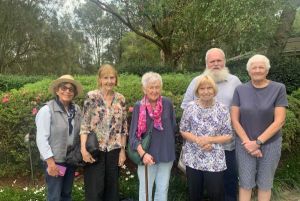
Carol Reynolds, Margaret Mahony, Alison Miller and Ros Pitt, together with our welcome guest, Nicholas O’Connor, gathered on Tuesday 24th March at Hurstville Museum & Gallery to use the current exhibition to encourage ideas for our writing.
‘Snakes and Mirrors’ by Petrina Hicks is a collection of large-scale photographs inspired by the use of mythology, fables and art history. The experience certainly opened up plenty of discussion, the results of which will no doubt appear on a website or in a publication somewhere in the future.
I highly recommend other groups use such community facilities, which not only provide public awareness of haiku poetry but are useful as alternatives to outdoor ginko when the weather is not always kind.
On Saturday 14th March, members Beverley George (convenor), Maire Glacken, Pip Griffin, Marilyn Humbert, Colleen Keating, and Kent Robinson met at our usual venue, the Gosford Regional Gallery, for morning tea before beginning our ginko in the ever-beautiful Edogawa Japanese Garden. The garden commemorates the sister city relationship between Tokyo’s Edogawa city and the New South Wales Central Coast city of Gosford.
In autumn sunshine, it was a delight to wander in the gardens, to watch koi and ducks in the stream and groups of children, accompanied by parents, running about excitedly near the pavilion, enjoying the unusual wild life and beautiful surroundings. As usual, there was plenty to inspire our haiku: pink-flowering rhododendron bushes, sparkling raked white pebbles, glimpses of the blue, shining bay through the palisade fence, the little Japanese bridge and the gently falling waterfall. We sat at different spots, jotting down haiku ideas, before going back to our meeting room to talk about our published haiku and/or book launches we are preparing, to share a haiku from a poet that had impressed us, and read aloud the haiku we’d brought, triggered by Beverley’s prompt, ‘unpredictable summer weather’.
Marilyn shared highlights of her very recent trip to Malaysia and commented on our haiku, sharing her expertise. I shared a haiku recently published in Echidna Tracks. Colleen told us she has been invited to read from her just-launched poetry book Ring the Bells at Words on the Waves Writers’ Festival on the Central Coast. Beverley showed us a lovely handmade haiku book, Winged Ones –birds of four seasons, by Satoru Kanematsu. She and Kent are planning a book launch of their delightful new haiku collection, Interwoven. The book will be stocked by Books Plus in Bathurst.
Photograph by Deb Robinson Left to right: Colleen Keating, Pip Griffin, Maire Glacken, Beverley George, Kent Robinson, Marilyn Humbert
After a very satisfying morning of reading and sharing ideas, our meeting finished at 12:30pm. Our next meeting will celebrate Winter on Saturday 13th June, followed by Saturday 12th September, celebrating Spring.
The submission window for the Haiku Society of America Rengay Award competition will be from April 1, 2026, to May 31, 2026. The contest is open to the public. First Prize is $200; Second Prize, $150; Third Prize, $100. The winning rengay will be published in Frogpond and on the HSA website. All rights revert to authors on publication. Rengay is a shorter, more accessible version of renku and an easy and fun opportunity for two or three poets to collaborate. Find more information at https://www.hsa-haiku.org/hsa-contests.htm#rengay
The autumn equinox – when day and night are of equal length – has been an important marker of seasonal change throughout human cultures. With the observance of seasons a significant aspect of haiku practice, the Australian Haiku Society chooses to mark the solstices and equinoxes each year. This Southern hemisphere autumn, as leaves of exotic trees begin to change colour and many of our native plants come into flower, we invite you to enjoy a selection of favourite poems submitted to Haiku Strings in previous autumns. You can find PDF booklets of all the Haiku Strings we have held to date on our Resources page .
footy siren picking the last ripe tomato Louise Hopewell, 2023
morning moonset the black swan’s bill blood red Cathryn Daley, 2023
disagreement morning walk together alone Carol Reynolds, 2020
dancing breeze a hoop pine seed glides in to land Quendryth Young, 2023
outdoor café more dogs in trendy coats than people Kathryn Woolfe, 2019
park bench a two o’clock shadow holds my hand Barbara Tate, 2019
Opera House an autumn breeze fills the sails Gavin Austin, 2019
flooded street a man rescues a teddybear Kathleen Earsman, 2019
fire glow the baby’s breath on my cheek Margaret Mahony, 2021
schoolchildren’s protest their hearts displayed on recycled cardboard Marietta McGregor, 2019
chilly breeze a spider’s thread shifts the moonlight Lyn Arden, 2023
rain clouds blackening the sky Carnaby’s cockatoos Maureen Sexton, 2023
last song . . . the busker turns to his dog Madhuri Pillai, 2020
slow steps a curving path walking to her grave Maurice Neville, 2021
dogs long gone— all their feeding bowls overflow with rain Ron C. Moss, 2020
With possible severe storms forecast, in the end only two poets gathered at Barangaroo on Wednesday morning 18th March. Remarkably, despite the heavy cloud, the rain held off for the whole time. The headland reserve was quiet, with few people about, so there was ample scope for contemplative walking.
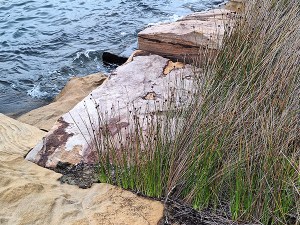
Penny set off on the middle path through the naturalised scrub and woodland, while I followed the rocky foreshore. The Barangaroo headland may have been artificially created, but it is slowly re-wilding.
We found inspiration among the weathering sandstone blocks undergoing colonisation by shellfish, lichens and moss, in the grasses, trees, and shrubs, some of which were flowering, from a couple of darters and the ubiquitous noisy miners, and the general activity of the harbour.
At the end of the ginkō we sat in a café on one of the old finger wharves nearby exchanging draft poems and discussing the value of workshopping with diverse poets.
What does it mean to die? To accompany another being as their life ends? Or to face your own death? Poets across the ages have responded with grief, rage, wonder, acceptance, and beauty. We want to read what death and dying mean to you.
confluence invites you to submit one haiku, tanka, or other Japanese short-form poem on the theme of death and dying. The best poems will share in $500 in prize money and be published in confluence. Submissions are open now through May 1, 2026. There is no fee to submit.
Catchment – Poetry of Place will remain open for contributions between 21 March and 21 May, towards release of the journal’s 6th issue online on 21 June, 2026. Guidelines and our submission portal can both be accessed through the following link: https://www.bawbawartsalliance.org.au/bcms/catchment/
As before, Australian poets working in Japanese-based forms can offer: either up to 5 tanka of a stand-alone nature; or a sequence of pieces, no larger than 4 tanka in total. Contributors may submit up to 3 poems in free verse also/ instead, each as long as 30 lines, likewise showing a sense of location. A biographical statement (no more than 50 words) should be submitted for each issue as well, please.
Discussions of Tanka on offer
In the meantime, 2026 will continue to bring you essays on poems of place, released each month under Catchment News & Views, accessible on the journal’s home page.
To coincide with the opening of our upcoming submission period, on 21 March I will be posting an evaluation of mine about portrayals of the marshland bird snipe in both haiku and tanka.
AHS members may likewise be interested in listening to a half-hour interview with me about tanka – broadcast recently on 3CR Community Radio (855 AM) – as presented by Di Cousens, a fellow member of the Fringe Myrtles Haiku Group in Melbourne: https://www.3cr.org.au/spoken-word/episode/discovering-tanka
On 21 April, readers can also look forward to a new piece by our co-editor Jo McInerney, who will discuss interactive sequencing created by tanka poets working in collaboration.
Rodney Williams Editor, Catchment – Poetry of Place Baw Baw Arts Alliance, Gunaikurnai country, West Gippsland, Victoria






 Australian Haiku Society