


Welcome to the second issue of the Australian Haiku Society’s Members’ News for 2026. This edition focuses on two upcoming events, and includes notices for two journal submission opportunities, plus contest success news. Read on for details.
- President’s Message
- International Haiku Poetry Day, 17 April 2026
- Queensland Poets Haiku Reading Event, 22 April
- Submission Windows for Australian Haiku Journals
- Contest Success
President’s Message
In this time of global uncertainty, with wars in other parts of the world that nonetheless impact our daily lives in Australia, as well as increasingly unpredictable extreme weather driven by climate change, haiku poetry can be a wonderful balm. It might be through composing haiku by paying attention to our immediate surroundings and circumstances or finding inspiration in small and otherwise mundane chores and observations. It might be through connecting with other poets on a ginko, in a workshop or simply by reading their poems, which inevitably bring different perspectives to our own lives. And in these difficult economic times, haiku can be a very inexpensive passion to pursue.
And speaking of connecting with others through haiku, ‘connection’ will be the theme of our International Haiku Poetry Day event this year.
The AHS Executive Committee met on 16th March. We confirmed that we will be running the fourth contest for the John Bird Dreaming Award for Haiku, opening for submissions towards the end of this year and closing in early 2027. To celebrate International Haiku Poetry Day on 17th April, this year we will be running a haiku string on the theme of ‘connection’. The mentoring trial has concluded and we are currently evaluating it. We will have more news on future mentorships in due course. A haiku reading event with Queensland poets will take place on 22 April. Our new Secretary is in the process of learning the ropes, and will soon be responding to inquiries.
Leanne Mumford
International Haiku Poetry Day, 17 April 2026
International Haiku Poetry Day is celebrated every year on 17th April. This year the Australian Haiku Society will be conducting a Haiku String event. We welcome contributions from haiku poets worldwide. The string will open on Friday 17th April Australian time and will remain open until 24th April. The theme of this string is ‘connections’.
Connections is a broad theme. Connection can take many forms and be between or to different kinds of entities. Connections might be between people or other living things, to nature or spirit, to place, history or culture. We invite you to explore through haiku and senryu varied connections in your own life and the wider world we all share. Further details are coming soon.
While AHS will be running a haiku string, we also invite poets and groups around Australia to celebrate International Haiku Poetry Day in other ways, including out in your community. Poets from Melbourne’s Fringe Myrtles group will be reading at Woodend Chamber Poets on 18th April.
What will you be doing? Please use the Contact Secretary form to let us know so we can promote your event or include a report on your activity in the next Members’ News.
If you are stuck for ideas, here are a few. Some are easy to organise spontaneously and others take a little more planning.
- Display haiku in your local library. This could be in the form of a ‘Haiku Wall’, or something more elaborate, such as a cherry tree made of cardboard. People could write haiku on pink blossom shapes to pin onto the tree.
- Organise a ginko at the zoo. You could even ask to have a display or reading while you are there.
- Leave a haiku or a chap-book of haiku anonymously somewhere public, such as on public transport or at a local café – anywhere you can think of where people might find them.
- In a similar vein, write haiku on rocks, leaves, bark, etc and leave those items in public places, such as neighbourhood parks. Or write them on postcards and leave them in cafes, your local library, etc. Write haiku on kites and fly them in parks, on beaches, etc.
- Post some of your haiku to your local community Facebook group.
- Offer to read some haiku on your local community radio station.
- Planning further ahead, many cities around Australia hold Japan Festivals that typically showcase aspects of Japanese culture. Why not approach the organisers about your group displaying or reading haiku in English as a demonstration of Japanese culture adapted to Australia?
- Or is there a local writers’ festival in your area that might be willing to host a haiku reading event?
Queensland Poets Haiku Reading Event, 22 April
AHS is hosting an online reading by Queensland haiku poets on Wednesday 22nd April from 7.30pm AEST. While Queensland poets will be reading, the event is free and open to all interested poets to join. However, you must register by 9am AEST on 22nd April to receive the Zoom link. The programme will include a brief presentation from AHS, the planned readings and an ‘open mic’ session.
Link for the Registration form.
Submission Windows for Australian Haiku Journals
Echidna Tracks
Echidna Tracks will now become an international publication, and welcomes submissions from haiku poets worldwide. As Echidna Tracks nominates haiku for the Touchstone Awards and the annual Red Moon Press anthology, be sure to send your best previously unpublished haiku/senryu on any topic. Gavin Austin and Marilyn Humbert will be the haiku editors for the next issue.
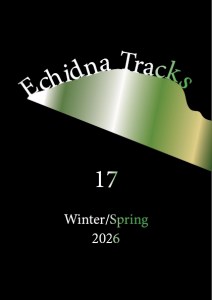
Submissions for Issue 17 will be open during April 2026. Please carefully read the guidelines on the Submissions page, as these have changed. Submissions will be received only via the submissions form.
Creatrix Haiku
The submission closing date for the next issue of Creatrix Haiku and Poetry Journal is midnight (Perth, Western Australia time) on 10th May for the June issue. Creatrix is a journal of WA Poets Inc.
Please visit the March 2026 issue #72 for a taste of the haiku Creatrix publishes. Scroll down the Submission Guidelines page for details of how to submit haiku and senryu via Submittable, as well as guidance on what the editors look for in haiku and senryu.
Contest Success
Congratulations to the three Australian Runners Up in the Snapshot Press Haiku Calendar Competition 2026: Marietta McGregor, Vanessa Proctor and Rob Scott. Their haiku will appear in the 2027 calendar. Snapshot Press is a leading publisher of haiku and tanka books based in the UK.



 Australian Haiku Society